


Introduction
Some months ago, I invited three interlocutors with different metaphysical commitments to a Signal chat with me over the course of five days to discuss the role of myth. The deal: they would be anonymous to one another, with aliases used in the chat—until the end. We are publishing this Trialogue using their real names. It has been edited for flow and clarity. - Luke Burgis.
Michael Nielsen is an Australian-American quantum physicist, science writer, and computer programming researcher living in San Francisco. His books include Quantum Country, Neural Networks and Deep Learning, and more.
Dylan O’Sullivan is a writer, and the creator of Essayful on X and Substack.
Michael Bonner is a communications and public policy advisor, and a historian with a PhD from the University of Oxford. He is most recently the author of The Crisis of Liberalism.
Luke Burgis: Are myths relics of the past—stories we’ve outgrown—or are we always generating new ones? How do myths relate to truth: do they illuminate reality, distort it, or do something else entirely?
Michael Nielsen: A successful myth is a (powerful, strongly shared) meaning-making story that explains our place in the world, some core aspect of life.
I’ve been revisiting the French Revolution, especially how all these new mythic ideas were established: freedom, liberty, equality! The People! And so on: all changing the basic myth of France. Of course, those ideas were grounded in earlier work by Locke, Montesquieu, Rousseau, and so on.
That time aspect is important: myth-making seems often to be a process, with the myth growing over time. As time passes, the “ecstatic truth” at the core gets clearer, more powerful. Maybe that’s part of what canonization means.
For example: the stories of Jesus almost certainly had far less force in his own time; they grew in importance over the decades and centuries after his death. The Gospel of John, which was the last composed, many decades after his death, goes much further in mythologizing him than the earlier Gospels.
I’m not sure the author of the Gospel of Matthew would have approved of the Gospel of John.
Dylan O’Sullivan: People make failed attempts at mythologization all the time. That’s the blessing and curse of modern man. Nothing is given, everything is for the taking. The past, which is the soil of myth, is seen as something to be escaped. The same is true of all tradition, all convention. That has left us deracinated; mythologizing alone, in the Robert Putnam sense. In this way, the collapse of grand narratives goes far deeper than art. It’s not merely that novels are plotless now, life itself is; or is said to be, at least. You hear a lot about the demise of shared facts, and how that’s contributing to political polarization and the like, but the demise of shared stories worries me more. If the burden of mythmaking is to be placed on the shoulders of each individual, our culture had better be readying us, as children or adults, to carry that weight. And I don’t think it is.
The (strained) relationship between time and myth also factors in here. What time offers, like space, is distance. Myths require a certain blurriness around the edges to take hold. The everything, everywhere, all-at-once nature of the Internet has rendered this almost impossible. It’s an environment in which old myths are not only dying off, but new myths are struggling to be born.
Michael Bonner: The word ‘myth’ originally meant ‘word’, specifically the spoken word. Thus it comes to mean very early on any sort of narrative or story. Aristotle notably even used it to mean the plot of a drama, but the word certainly had an ancient, prehistoric connotation in certain contexts also, as in Plato’s Republic, for instance.
No society has ever been without myths, and new myths will arise if the old ones are effaced. This is, I think, obviously true. But I always reach for the example of the Azande people. Advanced thinkers of the 20th century West might have applauded the complete absence of religion among the Azande. And yet, in place of even a rudimentary theology or creation story, witchcraft was an object of universal belief to a degree which even the most disinterested anthropologist might find shocking. One set of “just so” stories drove out another at some time in the remote past, and the absence of religion did not incidentally produce an enlightened society bereft of mysticism or superstition.
Our founding myth is Christianity, and there is no question that it has been much degraded by supposedly enlightened skepticism.
M.N: That’s fascinating about the Azande! Curious in what sense you mean they lack a religion? Presumably you mean something quite different from their belief in witchcraft. The linguist Daniel Everett claimed that the Piraha people lack a cosmogony: when asked what the origin of the world was, he claims they reply that things have always been this way. I suppose that’s an origin myth of sorts: a very, very minimal one!
Also curious: you imply that an enlightened society is one bereft of mysticism or skepticism. I’m an atheist, but I’m very struck by the enormous variation in belief among many of the people I most admire. The great mathematician Ramanujan seems also to have been, in considerable measure, a mystic: when asked where his extraordinary mathematical ideas came from, he claimed they were from the Hindu goddess Namagiri, in his dreams. I don’t want an enlightened society without Ramanujan and many of his fellow mystics!
M.B: Apparently, the Azande lacked everything from public or private cults to formal theology and even mere curiosity about a supreme being. They seemed to know that one existed, but that was it.
L.B: Are there scientific myths? Is “Progress” itself a myth?
M.N: A straightforward answer to the progress question is the numbers-and-facts answer: no, it’s not a myth. Along many (though not all) of the most important axes - many things have gotten enormously better. Far lower infant mortality rates than a century ago. Far higher literacy rates. Far lower rates of extreme poverty. And so on.
But I guess your question is pointing at something deeper, some internalized and maybe collectively held belief in a God of Progress, a Promethean God worth sacrificing at the altar of.
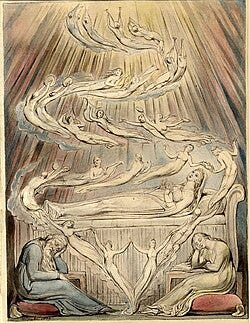
D.O: There was an ongoing joke on Norm Macdonald’s show, where his cohost would ask the guest: “Where do you get your ideas from?” It was funny because, as of yet, nobody really knows. It’s an irreducible mystery at the heart of both art and science. Some of the greatest contributions to science came from intensely mythically-minded individuals (i.e. Newton). Even some intensely atheistic writers I know have inexplicable rituals and superstitions, as well as cognitively-dissonant stances on Muses and the like. Cormac McCarthy has this fascinating article on the chemist August Kekulé, who discovered the structure of benzene in his dreams.
M.N: I’ve been reflecting on Bonner’s assertion that the Western ‘founding myth is Christianity.’ That’s true, but of course it emerged out of older traditions, and often competed with them. In the 4th century there was significant pushback on the rise of Christianity in Rome, with figures like Emperor Julian the Apostate renouncing the Christianity of his birth and attempting to establish a competing neo-Pagan church. I wonder how much it felt similar to our own time, with an old set of (formerly) dominant myths in decline, but new dominant myths not yet entirely established or sure of themselves. I suspect it felt quite unstable, much as both of you have asserted about our own time.
As a kid I bought into a false dichotomy between myth and science as sharply distinct ways of making sense of the world. Let me pick on Genesis. You read Genesis naively and think “there’s no way this is what happened.” It just looks ludicrous, a ridiculous set of stories.
But of course stories like the fall, the tree of knowledge, Cain and Abel, are deeply, deeply resonant. Science adds a few big ideas into our sense-making toolkit, and that makes it markedly better in a whole lot of ways - it’s changeable, upgradeable, decentralized (in theory), predictive in new ways. But the questions posed by a story like Cain and Abel or the Fall are every bit as deep as the deepest questions posed by science. In some sense, they’re at the foundation of psychology and political science and behavioral genetics.
Let me ask a request of everyone: why do you care? What are you hoping to get out of this? I don’t want this to be a generic polite cocktail-party conversation!
L.B: Do you consider yourself religious, or having a “religious sense”, despite being an atheist?
M.N: My atheism is a deeply held part of my identity, something I arrived at and defended as a child. In that sense, I rejected religion quite thoroughly. As an adult, I’ve gradually come to believe that whether someone believes in God is surprisingly irrelevant to whether they’re religious.
M.B: Do you think that there is a kind of peculiarly Christian atheism?
M.N: I was raised in Australia, which is predominantly Christian-secular. I was shocked as an adult to realize that, yeah, I wasn’t just an atheist, I’d absorbed a huge amount of Christian stuff, both intellectually and emotionally. Christ-on-the-Cross, the Sistine Ceiling, all of that—you can’t help but be affected, if you’re immersed from birth. It’d be fascinating to understand the differences between, say, Christian atheists and Shinto atheists.
D.O: How you understand and tell your story, both to others and yourself, is perhaps the cornerstone of one’s singular trajectory through life. It can be the difference between life and death. Myths are what Kenneth Burke called “equipment for living.”
M.N: We’re nearing the end of the second day of this three-day trialogue. I think the conversation is mostly bland boring generic stuff. It’s been disappointing. Does anyone have anything they really care about here?
M.B: At some point after I got married and began to have a family, it dawned on me that the world was very much unlike what I had expected growing up. None of the promises of a more peaceful, more enlightened, more prosperous world had come to pass.
It became clear to me that what had been widely believed about the world simply wasn’t true. Somehow, I was drawn to Christianity, after a lengthy period of atheism.
M.N: What’s the convincing argument for Christianity? One that I think is immensely powerful as a narrative is that God loves people so much that he sent his only Son into the world, and he loved us so much that he was willing to die (terribly) to save us. No matter your belief, that’s an incredible story.
M.B: For me, there was no “argument.” It was more like a phenomenological experience through art and music, probably mostly music.
M.N: One of my favorite experiences is participating in the Hallelujah Chorus in Handel’s “Messiah.” And a recent discovery for me is the huge Christian rock hit, “Oceans”, which I love!
Another favorite piece is the Hurrian Hymn to Nikkal, which dates to 1400 BCE—the world’s oldest piece of music. Here’s one modern arrangement.
L.B: John Henry Newman said that if we had to use a number to give a value to a single human life, the only fitting number would be infinity. If I’m married to my wife for another 50 years, I will barely begin to see all that is really there. I suppose it’s like realizing that each person was more like an entire universe that I couldn’t explore in 1,000 lifetimes.
M.B: Yes, and for me this realisation only seemed right, justifiable, convincing, etc., within Christianity.
M.N: I instinctively very strongly believe it, as an atheist. Maybe that’s part of the Christian culture which I’ve strongly internalized.
I’m also certain it’s strongly grounded in my background as a physicist. You end up with an enormous internalized felt sense for and respect of the capacities latent in matter. A single helium atom is incredibly complex; indeed, in some sense a single electron is immensely complex. Never mind the many, many additional layers of meaning in a human being!
L.B: I failed my Bridgewater final round interview because they kept going after me with the “would you torture one person to save the world” line of questioning, and switching it up (what if it was a stranger, what if it was a criminal, what if it was your mom), and while 23 year old Luke wasn’t particularly religious, and I don’t think I had a firm stance on torture—I went back and forth on it—I did keep trying to bring the question back to human dignity, even then, and was basically uncomfortable with someone being used in an instrumental way, for any reason, even if it were someone guilty of some deranged crime. True story. The three guys interviewing me just grew increasingly agitated. It was hilarious.
I don’t think it’s possible to really have that discussion without laying some metaphysical presuppositions on the table. “Are you guys all materialists?” I don’t think I actually asked that, because I did want the job and the money, but I should have.
M.B: I would say that most of Western culture doesn’t quite make sense unless you understand Christian belief. The western interest in free will, for example, is extremely peculiar, and arises from late medieval arguments but remains with us though its origin and meaning are forgotten.
D.O: I’m on European time, so damn, I’ve got some catching up to do.
To me, free will is tightly bound to the via negativa side of agency; the ability to do otherwise, which stems from the ability to think otherwise. There are different opinions about Julian Jaynes’ The Origin of Consciousness in the Breakdown of the Bicameral Mind, but an idea that really stuck with me is the rise of this “second voice” in the human mind, and how it relates to the evolution of conscience. The ability to engage in complex negotiations with ourselves about particular physical/psychological/metaphysical courses of action, to weigh counterfactuals and consequences (highly imaginative), without resorting to base instincts, seems central to how we use the term “free will.” Hence the legal idea of compos mentis, why a contract signed while drunk is void. We regard the drunk as raw instinct. They have the agency to sign, but potentially lack the negative agency not to. When a beaver builds a dam, it’s a marvelous feat of agency, but is it free will? I saw a video once of a beaver building a dam out of children’s toys in someone’s hallway.
L.B: What do you think is the most powerful story shaping the American public’s imagination right now?
D.O: One is the “myth” of meritocracy. Maybe we could say the central myth of meritocracy is something like: work as hard as you possibly can, and you will be rewarded. Now, this gets into interesting territory with respect to truth. Because it’s certainly untrue for some people, who work hard all their lives to no avail. But I think that’s the nature of myths: they’re generally true, not specifically true.
M.N: The myth of meritocracy - and I agree, it’s a myth expressed in many, many powerful forms - is one of those strange myths where believing it is often to your individual benefit, even if it’s in some sense terribly unfair to you or outright false.
I will be surprised if the most powerful story is not AI within five years. As one of many examples: substantial job displacement (perhaps through self-driving vehicles) will generate a huge amount of tension. You see this already in San Francisco, where there’s very mixed reactions to Waymo, with some people utterly loathing them. My most disconcerting Waymo experience was being in one that was kicked by a passerby, causing the car to go into a holding mode. The impact of humans forming relationships with these pseudo-people is going to have many strange and surprising consequences.
D.O: I think the myths surrounding AI are going to be tectonic, in both directions. AI-as-liberator versus AI-as-enslaver. Deeper than the myths themselves, AI as a myth-maker is also going to be formidable. Byung-Chul Han has written about the collective unconscious, which used to be embodied in humanity as myths (internalized religious, social, economic, political frameworks or narratives) are being replaced by a digital unconscious. One substructure is, almost invisibly, giving way to another. So after thousands of years, society is less built on stories now than algorithms, less built on atoms than bits. It’s hard to even guess how this is going to alter the evolution of human psychology, for the very reason that it’s taking place at a resolution invisible to the naked eye.
M.N: Back to points you all made earlier, about the rate of emergence of myth, there’s an interview with Brian Eno where he observes that wonderful new musical instruments are now being invented every day, and as a result no one really invests the time to master them, in the same way as Yo-Yo Ma mastered the cello. In fact, we never even begin to touch the limits of any of these new instruments, and some of them probably have truly incredible possibilities.
D.O: Orson Welles said the artist should be always “out of step” with his time. Our hyperconnected world has rendered this near impossible. I read something about the disappearance of subcultures, in that they’re no longer given the time or space to develop true individuality. At the slightest whiff of rarity or talent, they’re immediately spotted and uploaded into the main culture. This leads to a great and stifling sameness, which I think we see everywhere now. Grunge needed a period of isolation in Seattle to become grunge, just as folk needed that period in Greenwich Village. Had they become immediately viral, I feel they’d have been robbed of their chance to grow into themselves
M.B: I’ve written elsewhere that cultural exchange would be basically impossible in a completely globalised world, as it very nearly is now. But perhaps a world of one vast homogeneous culture would have nowhere to turn for new inspiration but to the past.
L.B: To close things off, I’d like to ask each of you: Where did we dodge the hardest question—and what is it?
I’ll start. One of my favorite novels is East of Eden by John Steinbeck, which is based on the story of his own family ancestry which settled the Salinas Valley in California. Two of the characters in the story re-enact what is essentially the Cain and Abel story, and the author realizes that there is a dark truth at the heart of his own family, which is illuminated by this biblical story from Genesis. The book perfectly illustrates the connection between “myth and metaphysics” at the level of the family. It’s highly personal, and I think Steinbeck wrote the novel in part to distance himself from the darkness—he could externalize the truth in his fictional characters. So while I certainly don’t expect anyone to spill the family secrets in this Trialogue, I would say the hardest questions of all are often the myths held within our own families, which we inherit and are often not aware of until much later in life, if we ever.
I suspect that some of our collective myths as a society are not formed from the top down, but from the bottom up—through millions of smaller units, primarily at the level of the family, which affect broader, macro questions of identity.
M.N: Philip Pullman has observed that our lives begin when we’re born, but our stories begin when we discover that we’ve unaccountably been born into the wrong family. I suspect there’s at least a little truth to that for everyone, and sometimes a lot. There’s also the myths we cloak ourselves in, self-protective stories, stories to help us avoid thinking about certain things. By definition we are dodging these! And, every once in a while, external reality, the unself, may help us unravel one of these myths. Not always pleasantly!
M.B: In my own life, I had long dodged what I think is the hardest and most fundamental question. This question surrounded the meaning of death. It is the hardest and most fundamental, I came to discover, because the answer that you give to it will, I think, also tell you about the meaning of life. I found that things went in exactly that order. When I was basically an atheist, it was the question of death that violently started to my mind one evening in my early 20s and left me suddenly feeling a great emptiness because I could not give myself a good answer about it. It was the Christian myth, at the centre of which is a supremely meaningful death, that gradually helped me to formulate an answer. And, to tie in the family theme, deaths have loomed over my family history since before I was born, and one of the family myths involved the premature death of my father’s elder brother when both were boys: an uncle whom I never met, but for whom I was named. I had meditated on that death for a long time as a boy and its meaning for me and my family, but always in fairly superficial ways and without much seriousness. In later life, it was again the Christian myth that has helped me make sense of it all, to find meaning in death and life—difficult questions which one probably prefers not to confront.
D.O: I’m currently quasi-inebriated at a wedding, so forgive my ineloquence, but I’ll venture a layer deeper. The beauty of the greatest myths, stories, narratives, is that they serve as mirrors. Read Dostoevsky. You’ll see what I mean.


For me, this discussion brought to mind Tolkien’s poem, Mythopoeia, written for C.S. Lewis shortly after a walk and a discussion that would lead to the latter’s conversion a mere few days later. Tolkien’s poignant dedication was “To one who said that myths were lies and therefore worthless, even though ‘breathed through silver.’” This famous excerpt, below, seems to go right to the heart of myth, and its role in shaping our lives. It gives me hope, as we each labour in our sub-creations!
“He sees no stars who does not see them first
of living silver made that sudden burst
to flame like flowers beneath an ancient song,
whose very echo after-music long
has since pursued. There is no firmament,
only a void, unless a jewelled tent
myth-woven and elf-patterned; and no earth,
unless the mother’s womb whence all have birth.
The heart of Man is not compound of lies,
but draws some wisdom from the only Wise,
and still recalls him. Though now long estranged,
Man is not wholly lost nor wholly changed.
Dis-graced he may be, yet is not dethroned,
and keeps the rags of lordship once he owned, his world-dominion by creative act:
not his to worship the great Artefact,
Man, Sub-creator, the refracted Light
through whom is splintered from a single White
to many hues, and endlessly combined
in living shapes that move from mind to mind.”
The hardest question you three haven't posed is the question of American history. The myths about the origin of this country, its shared stories are based on fictions, just as Christianity is. The genocide of the native populations and the slavery of African peoples are stories that are true, but way too destructive to admit. So they are ignored, sublimated and covered over with other, less true myths, like Christianity and Columbus, and western progress. When will we ever face the reality of racism and how it forms the basis of the division we see today in practically everything.