


Irene wanted resurrection. It didn’t seem like too much given the state of things. The state of things was that for a long time she had been in bed. She was told that if she moved, something inside her might burst. And then there was Pollard. The state of Pollard was that Pollard was dead.
“But how do you expect a resurrection without even a body here?” asked Reverend Slate.
An odd place to draw the line, Irene thought.
When he was alive, she had received visits from Pollard on Sundays and Wednesdays. Mostly he sat bedside, eating the hot meals he brought and growing increasingly bothered. Irene tried to calm him down. She told him his head was like an apiary, like a box with slats and bees inside. He talked about riding bulls. Bull riding was his purpose, he told her, his calling, and sometimes he listed everything it would take to achieve his goals. It was not only staying on the bull, he explained, it was matching the bull’s movements with your own. When he wasn’t talking about riding bulls, or denouncing the many people who did not support him in his calling, he sometimes read to her from the scriptures, a thing he seemed to think was part of his responsibility being there.
Her body was beyond saving, and her soul, such as it was, was a flickering thing. She could feel the bones in her legs beneath the blanket. She could feel the blanket on her bones. She hoped only that she might evacuate her body, bit by bit, until there was so little of her left that the body could die while she looked on idly. She wanted to abandon her body, to move discreetly away like she had once moved when she was still young and lovely, her legs, incomprehensible, carrying her silk-footed across the cracked back porch, down the steps, into the alleyway lined with garbage cans and rosebushes.
Pollard told her who was having babies and who was getting married. He held pictures of smiling families in front of her face.
Sometimes she woke to Pollard’s chest as he reached across. “Oh,” he would say. “I thought you were asleep.”
She could not remember when he first arrived, or how long he had been visiting. He came on Sundays and Wednesdays, but the days were wobbling. Tuesdays and Thursdays seemed to have disappeared entirely.
“Don’t put yourself out on my account,” she told him more than once. “I’ll call if I need anything.”
If he heard, he ignored her. He was still there, and when he wasn’t there, she sometimes wondered if it was him around the corner in the next room mumbling.
“You have as much to offer me as I have to offer you,” he told her. “And I don’t say this to just anyone. I don’t want you thinking this is the sort of thing I do, say this kind of thing to just anyone I visit. I am generally a very closed-off person.” This last thing he said like it was a thing once told to him that he was now repeating.
There was a window beside the bed and when a fog settled over the yard, Irene could hear the clip of her mother’s sharp voice arriving as it would arrive through a fog. Come along and stop dawdling, and following the fog’s retreat—her mother’s voice guiding her—Irene was led to the lake not far from the country house, where the fog settled on the water like a plume of smoke, and there, standing in the lake: her mother, the image of a woman from a storybook, a distant woman, a wax statue with button eyes, mossy stones for waders weighing down the hem of her skirt as she washed cabbage and carrots in the steaming green waters.
She had done it, Irene thrilled. She had died without fear, without knowing she was dying, and now her body was gone, good riddance, away, and she had found her mother’s second body in the lake, and in the fog, surely, her father too and all the rest of them waiting.
But then she felt his hand on her arm and smelled Pollard in the room and knew she had only closed her eyes and that it wasn’t over yet. And it wasn’t even Pollard—Pollard was dead. Pollard had beaten her to it. “Irene,” Reverend Slate was saying. “Did you hear what I said? There are others who can come visit you. You won’t be left alone.”
When she was young, just a small girl in the basement of the church, a boy had come to her and asked if she wanted a touch from God. She said yes. The boy said for her to lift her dress and show her stomach. And so she did. She felt a rush of blood in her cheeks because she knew what she was doing was untidy, but she couldn’t help herself in case the boy had some secret knowledge. The boy bent while she stood with her back to the cinderblock wall, pressing herself against the drawings of green and blue crosses on sheets of white paper taped to the wall, hosts of angelic forms hovering over scribbled mangered babies. And though she couldn’t see him, she felt the boy blowing a thin stream of air over her belly. She imagined his puckered lips. She felt warm all over. She imagined him imagining the Holy Spirit riding on his breath. When he stood, the boy was radiant.
“Did it work?” he asked eagerly. “Do you feel any different?”
Yes, she told him. She felt new.
“But how will we know?” the reverend asked. “How will we know without a body here?”
She could hardly stomach this man. They would know when Pollard returned, of course. When, on Sunday or Wednesday, Pollard strode once again through the door looking at least alive, with slight traces of the afterlife behind his eyes. That’s how they would know.
“Father,” the reverend prayed, and she felt his clammy hand on the back of her own. Maybe this was all others wanted, she thought, to be appeased, to be clammyhanded and held, but what she wanted had nothing to do with that. “Father,” he prayed, “we ask that it be done in accordance with your will—” It was like sitting with wet bread, his words like soggy bits of it dissolving on the surface of the water.
As far back as she could remember, Irene had a way of distinguishing souls. There was this life, and there was the next life—both of which received too much attention, she thought. Not enough attention was paid to the life between the two, the place where souls stayed.
Pollard’s soul was chalky and strained, with marks like pin knots all over it that would easily cave if pressed. His soul was like a crumbling, misshapen fingerprint cookie. That’s how she thought about it in physical terms.
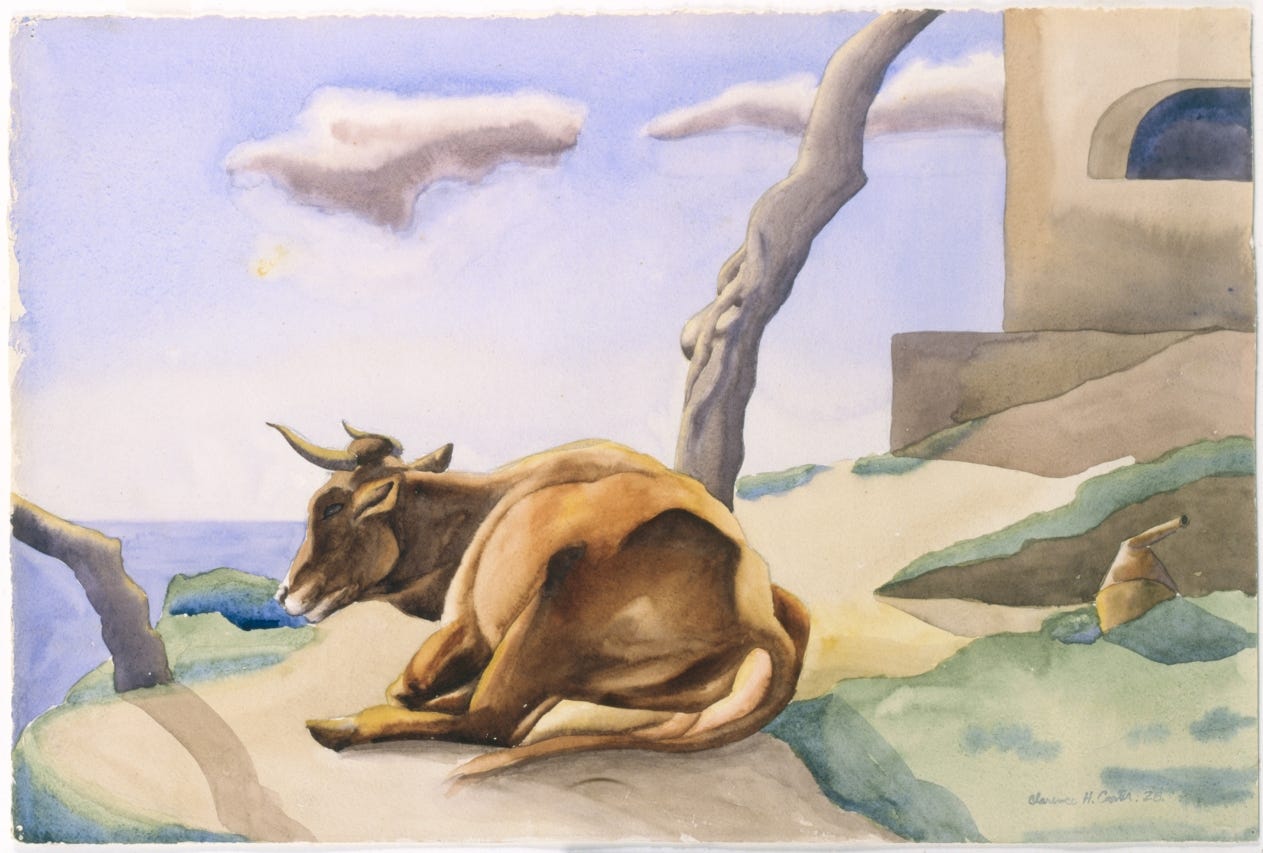
On one occasion, he brought her pictures of a bull. “See this here,” he said, pointing to the upper foreleg. “1,700 pounds of muscle.” A real honker, he called it, a head hunter. The bull was named Two Places At Once. Irene looked at the pictures as he held them in front of her. The bull’s hide was white all over with golden shades, vicious little horns curved down the sides of its massive head. A fatty mound rose between the bull’s shoulder blades. The slanted, almond eyes of Two Places At Once were tired and resolute, and the patch of hair between the eyes was darker and curly and more golden than the rest of the bull’s pale body.
“Feel this?” Pollard held her hand against his arm where the muscle, beneath his shirt and his skin, formed a small fibrous hump. “I stayed on for ten seconds,” he told her.
It took great effort to get the reverend to understand what she wanted. “Oil,” she said, stretching the single syllable into two, and after repeating it like this and repeating her instructions, he rose, finally, and brought her a cup of cooking oil from the kitchen.
Sometimes, when Pollard was cruel, moving her too roughly, tucking her sheets tightly beneath the mattress, flattening her legs to the bed, she would look in his eyes and see many other souls mingling with his, and she knew then that he was not looking at her alone, that many others were with him, watching her in the bed, watching her and daring her to keep on living a little longer, looking at her from a place without good footing, these other souls mingling with Pollard’s soul and all of them on the verge of slipping and falling away.
The cooking oil was yellow and sludgy in a clear glass jar. “Is that all?” the reverend asked, and Irene waited for the click of the latch before she tilted the jar so that the viscous, yellow surface of the oil broke into a stream over her cupped palm, coming faster over the lip of the jar than she’d anticipated.
Not having a body to anoint or anywhere sensible to spread the oil, she drew a sign of the cross in the air with her thumb. The oil was running down her wrist and across her forearm. Oil drops stained the bedsheets green.
When she had done it and chosen words that matched—as nearly as she could remember them—words spoken in the scriptures—she lowered her hand to the mattress.
No tongues of fire, no winds. If it worked, and Pollard returned, he’d be in no shape to ride. He’d be weak, undoubtedly, and what kind of life would that be?
Irene folded the sheets below her knees. She looked at her skinny legs and, with the aid of slippery hands, lifted one after the other and slid them over the edge of the bed. To the window, to wait.
Then there was light—too much of it. Everything in the room bright and swimming, stabbing light like a new kind of darkness, glittering at its edges, throbbing and distorted. She steadied herself on the table—on her knees now—next to the bed, feeling for the window sill. A clap of thunder, a descending cloud, waiting for the trees to catch on fire or for the ground to shift beneath them, the rush of a hawk or an owl’s wide wings approaching, anything like this would do, but all she heard was the clattering of the jar and something else falling—the clock maybe, a soft thump. The leftover oil pooled at her knees, darkening her gown. She heard the sound of the door behind her and turned, dazed, half expecting Pollard to come through the door dressed however he’d been dressed for burial, or if not Pollard, her mother then, with stringy wet carrots hanging at her side, her father even, his shirt unbuttoned to the waist—but there was no one at the door and the room was empty and dark. The walls of the room were untrustworthy and cut off from one another. The only light was the light from the window and the fog out the window pressed toward the house. Somewhere within the fog was the swaying form, dashed white against the white fog, trudging unhurried beneath the indifferent weight of its immense muscled body—Two Places At Once. It stood in the fog watching the house with beady almond eyes, its pale flanks wet with water and dripping.
