


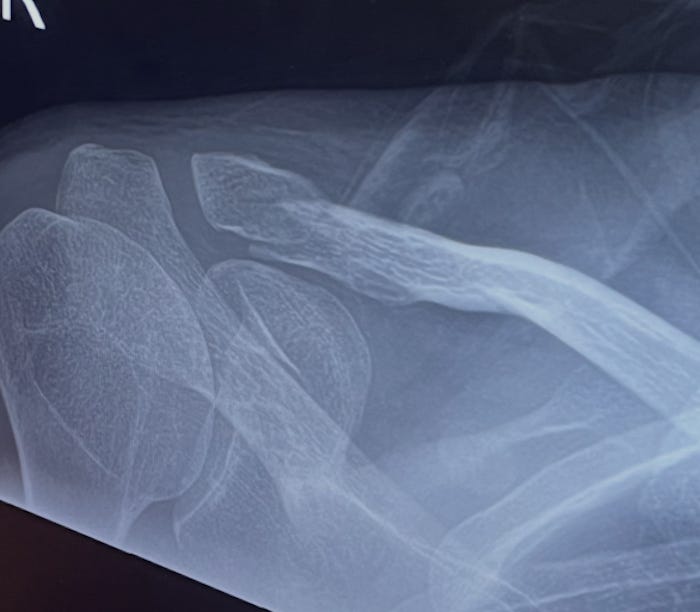
For the last few weeks, there’s been a monster living with me. He wakes up and thrashes his tail whenever I leave him out of some mundane activity: leaning to pick up a fallen spoon, putting on my socks, taking off my socks or trying to get into bed. We’re both big fans of painkillers. We’ve been living together since I broke my shoulder.
What happened was that I went out with my brother for his birthday (20th November if you wanna send him a card.) That morning, I swapped my trusty Timbs for my relatively dainty Nike Dunks. We had a bunch of drinks at different spots—I didn’t count how many. As we were leaving the last pub, I stepped down from the doorway onto the street. Or I tried. My back foot was not where I expected it to be, no longer twice its normal size in a Timberland. I overstepped, I tripped and fell with a thud onto the pavement—the slapstick classic. I heard a blitzed girl drawl, “Oh, my god…” on impact—one of the traditional sounds of London nightlife. I scrambled upright and wished my brother a happy birthday before he went for a midnight feast at McDonald’s. No biggie. I mean, I fall down a lot.
Earlier this year, I broke my toe tripping over a stick looking for the grave of a vaudeville comedian, a tribute act that was both fitting and painful. I’m so flat-footed that an orthopedic specialist once called over a colleague to marvel at the sublime mystery of my clodhoppers. I stood in my examination room shivering in my underwear. I promise you, no matter how many slack-jawed medics tell you that you’re rare, you don’t feel special afterwards—you feel lonely.
I got the bus home. A nice lady pointed out I was gasping from pain and I waved her concern away like a dandy lightly wounded in a duel: “Merely a scratch, I assure you!” I crashed onto bed and snoozed. It was only when I woke up the next morning and couldn’t get my shirt off without a lurch of nausea and some wicked flinching that I thought, Maybe I should get this checked out.
I’m lucky enough to belong to the cadre of freaks who like hospitals a lot. They’re a whole world within the world, humming away. I have warm childhood memories of blonde angelic nurses leading me down labyrinthine corridors that smelled like medicine cabinets—artificial pine, disinfectant, alcohol, gauze. I’m happy just to wait somewhere and hang out inside my brain. Also, on a Friday morning, the emergency room is weirdly chill. There’s one guy asleep on the floor and a middle-aged woman who insists she needs to be seen next for reasons known only to her (there’s someone like this in every emergency room in the world), but other than that, it’s people sitting still, mumbling, roaming around the wilderness of their minds while occupying physical space, or staring at their phones—all totally normal.
Maybe I’m OK because this isn’t my first time. When I was twelve, I went to a birthday party disco held in a Holiday Inn. A pack of boys hyped into madness by the discovery of a condom machine in the Gents’ toilets knocked me down on the dance floor and broke my tibia. I huddled in the lobby waiting for my mum and trying not to cry while the DJ, a morose white-haired ogre in a Hawaiian shirt, sat next to me and smoked. My mum was a doctor in the NHS for forty years and flat-out refused to go to A & E on a Friday night when all the gore, trauma and chaos would be at their peak. On Saturday, she gave me codeine for the pain. I gulped it down while E.T. was on TV, and by the time Elliott and the alien got airborne I was higher than either of them. I stroked the screen.
Another time I somehow lacerated the flesh around my ankle getting out of the shower and left bloody footprints all over the floor. My dad was downstairs air-drumming to Abraxas by Santana so he didn’t hear me yelling. The foot got infected, blowing up all red and infected like a clown shoe made of meat. Probably the most painful was the time I accidentally emptied a panful of boiling hot water into my left sneaker. My brain caught fire; I yowled like Tom from Tom and Jerry when the piano lid smashes onto his tail. I remember the thin sizzling noise as I pulled off my sock—the layer of skin came away like silk. The pain afterwards was like I’d dunked my foot in a cloud full of lightning. An underrated aspect of injuring yourself is the psychedelic aftermath. It redefines your relationship to time and space.
I’m seen by a nurse. She asks me if I want something for the pain. I try not to sound too thrilled. She asks me if I hit my head. I say, Nope, throwing the pills into my mouth like I’m performing some weird party trick because I can’t lift my arm.
“Hey, your face is bruised,” she says in a fearful cartoon puppy voice. Her scrubs are siren blue.
It’s never occurred to me that my face is my head, although obviously it is. She sends me for an X-ray.
Things around me seem to be happening but also to be totally dreamt at the same time, which is magnificent. I stare at a clock and roll my tongue around my cheek. A red-faced man explains in detail how the steak at his daughter’s birthday dinner was a disappointment: “Look at the color, mate, tell me that’s rare. That is well done.”
One porter tells another, “If you’re in there, you’re there.” An old woman looks at me benevolently. I’m in this gooey dreamscape prickled with nausea for about forty minutes before I remember that I need to tell someone why I’m there. The X-ray confirms the break. My arm is nestled in a fetching blue sling. Another nurse wolf-whistles at my X-ray. “You’ve done it!” she calls down the hallway. I remember I was trying to cook up a metaphor about existence itself being a long hallway between two doors at this point and thinking I’d probably stolen it from Beckett. The nurse tells me I’ll get a call about a follow-up appointment but nobody can tell me when that might be. “There’s no Caller ID,” she says with a Wonderland grin that acknowledges the lunacy of the situation without trashing it, “so a lot of people, they never answer the call, never show up.”
At 3 a.m. the next morning, I try to get out of bed without using my right arm to help me balance. I go cubist, I writhe. I decide I should probably go back to my parents’ house for a little while.
Back home, there’s no time. Days just melt together, grey and sleepy. Normal things suddenly scare me—stairs, mud, toast. OK, the first two aren’t hard to fathom—what if I slip on mud or stumble down stairs in my wonky state and hurt my shoulder again? But it’s suddenly revealed, too, that making toast involves a baroque duet between the right and left hand which I can’t perform anymore. Without even thinking, ordinarily I’d use my left hand for traction on the counter while I spread butter on the abrasive wilderness of the toast with my right. My hands don’t like being repurposed. I’m Edward Scissorhands trying to use a knife and fork at dinnertime. I have to cajole my socks onto my slab feet with my big toe. I’m bad at this.
My mum gets pills from the pharmacy. She says, “Well, just take six a day and see how you feel…” I don’t use the bathroom for five days and when I do it’s a mystical experience, like birthing a griffin. I stare at the winter sunlight inside some raindrops on my window and think, Yes. The dead trees outside nod in magical agreement with me like tired witches. I’m floating above my normal mind for several days, thoughts coming to me like debris on a multicolored breeze, nice and soft. I pick up a copy of Bleak House and start laughing but I’m not certain why. There’s a huge bruise like a toxic waste spill oozing from the knuckle of my shoulder to just below my right nipple, rotten tooth yellow. It’s so tender for a couple of days, the air around it tingles, halo’d with pain.
Meanwhile, my unconscious has massively upped its production budget. I begin having mad vivid dreams every night. I’m somehow both watching and fighting in a boxing match where my opponent is telling me to stay down—depressingly obvious symbolism. I’m a fire engine. I’m riding an enormous dog across the surface of a dead planet and then I’m the dog eating tons of fudge from a wrecked shipping container. And then two furry green arms are cuddling me on a rollercoaster and I know they belong to something like an angel and my brain is flooded with joy. I wake up tired, my face and pillow coated in drool. Two days into this woozy hibernation phase, my friend texts to tell me she had a dream about something bad happening to me on the night I tripped up. Every time I stand, I say, “Whoa…”
This is when being in the land of illness is kind of a golden treat. If you blank out the flammable rushes of pain and horrible dream residues haunting your wide-awake life, it’s pretty good. It’s like permission to disappear. For a little while, nobody expects you to call back or do anything except read about legal chicanery on foggy Victorian streets. It’s literally fine to be in your childhood bedroom jellifying.
Inevitably this soon wears off. You become aware of how tired you are from the slow healing of a bone you never appreciated. You make lists of all the things you can’t do. Suddenly you’re trapped alone with yourself, newly powerless and fragile, in a kind of psychic abyss. Beyond the boredom lies the fear and beyond the fear lies the horror of what comes next.
Eventually an email summons me back to the hospital. There’s one of those sinister Amazon storage vaults in the main atrium. Are the patients getting stuff delivered there? Do they creep down at night and then sneak back to the wards to unbox power tools in bed? A kid’s spinning in circles and sobbing. A shellshocked faun with two broken legs is wheeled down a corridor.
I’m seen by a precise young man named Moritz—German or Swiss, I’m guessing—who explains the nature of my break to me. “No gym, no weights, no bike for three months,” he tells me. This is an epic tragedy. How will I pull through? I do none of those things. I fear the gym. I’m ambivalent about being outside unless I’m with a dog.
I ask Moritz if it’s a clean break. He says, “Clean is not a word we like terribly much in orthopedics because it implies dirt or infection at the site of the injury. The bone did not pop out. There is no evidence of infection.” He says, “You seem a reasonably happy bunny to me.” I nod. “We talk in bones about displacement,” he points to the fracture on the X-ray with his pen. “You can see here,” he says, “where things, they are displaced.”
The monster purrs under my skin: he goes to sleep but he doesn’t disappear. This morning in the mirror, the bruise was dark purple, like a storm cloud. Now, I stare at my bone on the screen. It glows.
This essay is part of Strange Visions, our ongoing series on defamiliarization.
