


We live in an age of stylized truths and simplified realities, video snippets and short-form fragments of text that each claim to stand in for reality itself. Describing how short-form, aphoristic writing related to the radically “cutup” and abbreviated media landscape of the early twenty-first century, Jean Baudrillard sought to draw some distinctions between these kinds of content. “The aphorism, the video-clip and the advert seem to share an instantaneity, rapidity and ephemerality,” he allowed, but the aphorism represented a different kind of phenomenon:
It’s a fragment, but a fragment that creates a whole symbolic space around it, a gap, a blank. Whereas our techniques and technologies create the instantaneous, but linked by continuity with the whole network. They are networked fragments, if I can put it that way!1
Aphorisms (while they might superficially share the fragment’s brevity) are dense, compacted, and complex statements of truth that are often posed in the form of riddles or paradoxes. They stop readers in their tracks and demand to be unpacked. Their meaning tends to make itself apparent only after a period of meditation. The kinds of media fragments represented by the video-clip and the advertisement, on the other hand, only make sense when viewed as constituent parts of a larger stream. They capture viewers’ attention only momentarily before the next piece of serial content in the queue makes its appearance.
The tensions between the word and the stream have only intensified in the twenty-five years since Baudrillard made his remarks. The most obvious contemporary manifestation of Baudrillard’s “networked fragments” is the algorithmically generated social media timeline or newsfeed. Here, various “shards and fragments of discourse” are placed in relation to each other and the assemblage presented to the end user as a supposedly faithful representation of current social reality itself.2 However, social media has just as profoundly reshaped our understandings of writing itself, rendering it, too, into a series of fragments within a network.
When users join social media, they are given a profile, which both authorizes and assumes responsibility for whatever content is posted under its name. Profiles work via a logic of networked affiliation. On X and Bluesky, for instance, statements and ideologically-coded emojis entered in the free-text biography and display name fields enable users to position themselves in ideological space and to affiliate their profiles with workplaces and institutions, as well as with political movements and moral causes. These are complemented by the “public displays of connections” (lists of following and followed accounts) accessible from users’ profiles, which provide additional evidence of network affinities. Those who encounter these profiles in digital space will (provided that they are familiar with the visual “codes” of affiliation on X and Bluesky) know in advance where their creators stand in ideological and political terms. Users can further indicate that they are members of their communities “in good standing” by editing a profile to keep it “up to date” as new norms of ideological signaling or new “causes” gain currency within particular follower groups.
Ideologically coded profiles signal to the like-minded while simultaneously deterring those from different platform subcultures. They also contribute to a phenomenon I call metadatafication—the way in which status and reputation online is influenced by users’ network affiliations. Metadatafication inheres in the impression given by the other users one chooses to follow, or the ideological flavor of the content one chooses to post or reshare. In a world of linked profiles, whoever one chooses to associate with, link to, or follow back, has become a marker of credibility. Information, too, has become newly coded by the logic of metadatafication, according to who shares or engages with certain “facts” or particular sorts of content, and who rejects or ignores them.
Knowledge has been reduced to its associated topics, relationships, and keywords. Follow circles, filter bubbles, and digital cliques may seem congenial to those within them but will inevitably appear alienating to those from outside. We still lack an agreed-upon language to describe what this sense of being involuntarily exposed to “someone else’s bubble” feels like, beyond a general unease when faced with unfamiliar facts, or an information environment that is not our own. Anxiety is therefore the defining emotion under the regime of metadatafication, particularly with regard to ambiguous or as-yet undescribed material or figures located on the edge of bubbles of acceptability. Is it safe for us to engage or connect with these people or forms of content? What might these engagements say about us? Is to engage necessarily to endorse?
We have been culturally conditioned to accept a certain kind of condensed writing and speaking as an urgent expression of an underlying truth. As the literary critic Ben Grant writes, the aphorism (crystalline and gemlike in its textual economy) tends simply “to declare what it says as true, and to brook no response.”3 Dicta similarly declare what they say to be beyond question. Protest slogans are devised in order to be unerringly and unquestioningly repeated. When chanted in ritual fashion by crowds, they resemble charms or spells, creating the illusion that their demands could be brought into being through the simple act of ardent mass expression. Although the vast majority of social media posts lack the verbal complexity and involuted cleverness of “classic” aphorisms, they have arguably inherited some of the cultural legacy of the aphorism, the slogan, and the dictum.
The assumption that what is condensed and immediate is also somehow true is intensified by the affordances of social media. The profile claims to represent the poster’s “authentic self” at its most unguarded (and therefore “real”) level, granting whatever is posted under its authority the seal of personal truth. The newsfeed and timeline make similar, quasi-aphoristic truth claims. Their constantly self-updating immediacy mimics what Susan Sontag calls the “rapidity” of the aphorism, the sense in which the aphorism’s recipient “gets” the truth “fast.”4 In the same way that early Midjourney fakes like “Balenciaga Pope” hacked into a culturally specific cognitive weakness (the belief that the camera never lies), the baseless online assertion exploits our cultural expectation that speed and concision signal the presence of the plain truth.

During a meeting with X employees in October 2023, Elon Musk claimed that the social media newsfeed was not simply in the process of replacing the news media, but that it was somehow resolving into an unmediated expression of collective psychic reality itself:
There’s really, I think, a profound shift in news. When you really think about information, I sort of approach this as like the collective consciousness, where if you can think of humanity as a superorganism and all the humans are basically the eyes and ears of the collective mind of humanity, you want to have all those eyes and ears feeding information into the collective mind. Not going through the slow and often distorted lens of media but actually just directly.
Instantaneity, combined with human connectedness, fosters the illusion that what appears on the timeline is unmediated and, in Musk’s words, “direct.” It resolves in real time into the thing in itself rather than a belated and “distorted” media representation of it. If there is an ideology of the timeline, it is fundamentally fractal or hologrammatic, representing the logic of the network itself. Every part is supposed to contain (or at least reference) the whole. The most globally circulated fragments of discourse and moving imagery posted to the stream—a stabbing in a train carriage captured by surveillance cameras; a shooting on a Minneapolis street—scale up into absolute truths imbued with an immediate planetary significance. However, what we might call “the algorithmic construction of social media reality” militates against Musk’s naïve (or cynical, or naïve and cynical) suggestion that the newsfeed represents some kind of “human superorganism,” whose every pair of eyes and ears has access to the “full picture” through media participation.
The mass audiences that existed up until the early twenty-first century were temporally synchronized around their consumption of the same programmed media objects (broadcast television; cinema releases) together at the same time. Now, however, programming works differently. Audience members continue to consume media objects en masse and at the same time as one another, but the feed is personalized. The old monoculture (centered on the shared exposure to the same content) has given way to a new monoculture (centered on synchronized behavior on the same digital platforms). Increasingly, what the content-siloed members of the new media audiences have most in common with each other is the fugue state of simultaneous screen fixation. However, rather than leading to a state of total atomization, this divided state of affairs instead intensifies the desire of all parties to represent their own algorithmically constructed social realities as normative and universal.
The need to be seen “communicating what is right” (and one’s own affiliation with that rightness) has led social media users to become skilled in a particular mode of writing—cant. Cant, as Todd Gitlin defines it, is the reduction of speech to sloganeering. It is “the hardening of the aura around a concept.”5 Like the dictum, cant acknowledges no legitimate opposition to its point of view. Each statement stakes a claim to absolute truth. Ideas and political positions are made to seem unimpeachable through the armoring of the language in which they are expressed. Cant simplifies, compresses, and places an enormous stock in the sincerity of the speaker, but, as Gitlin writes, that claim to sincerity “also protects it against scrutiny.” Cant has now become the dominant register in which political and academic arguments are conducted on social media. Anchoring one of her daily anti-immigration posts on X in the coercive moral certainties of the Second World War, the right-wing British journalist Allison Pearson reposted a picture of an exhausted Royal Air Force fighter pilot taken during the Battle of Britain with the text: “Imagine if [Flight Lieutenant] Brian Lane came back and saw what they’d done to the country he fought so valiantly for.” A reply to her post countered this emotive historical simplification with some emotive historical simplifications of its own: “He didn’t fight for a small, fearful England. He fought against the hate that divides us. Brian Lane flew beside Indians, Muslims, Caribbeans, Poles, people from every corner of the world who stood together to defeat fascism.”
Cant inevitably invites its opponents to express their arguments in its own terms. Both sides seek to have the final word, but finality is impossible given the endlessly self-regenerative nature of the social media stream. The discourse thereby devolves into the repetitive sparring of binary moral certainties—fragments purporting to offer the whole picture. Each piece of discourse manifests as a series of capsule “truths” and snippet-sized assertions (“fought so valiantly”; “the hate that divides us”), each packed together like alleles in the pared-down genome of a virus. While they deliver maximum emotive payload for minimal semantic content, each seems capable only of maintaining the balance of the polarity itself. There is no final resolution, only the armored intensification of emotions and moral certainties on either side of the divide.
With the ability it offers users to snippet images and discourse and paste them into new contexts, social media has become the ideal medium for perpetuating the culture war. When Tate Britain organized its “Hogarth and Europe” exhibition in 2021, it generated immediate pushback from visitors, who posted images of the exhibition’s gallery texts on social media (with their own derisive commentary), and then from journalists in the right-wing British press, who turned those initial posts into news stories. However, what was also notable about the exhibition’s wall texts was how they, too, seemed like a series of “networked fragments,” governed by similar social media logics—simplification, the need to immediately grab a reader’s attention, and the anxieties about association typical of metadatafication.
In the exhibition, The Tête à Tête (the second painting in Hogarth’s Marriage-A-la-mode series) was accompanied by a wall text that focused on one tiny detail in the painting—the pamphlet visible in the pocket of the steward, who is exiting the composition with his sheaf of unpaid bills. The caption writer (the University of Pennsylvania’s Chi-ming Yang) noted that the pamphlet’s title:
references a sermon by the Methodist evangelist George Whitefield, who preached moral purity in North America and Britain while helping legalise slavery in colonial Georgia in 1751. However indirectly, in this painting the atrocities of Atlantic investments are invoked in relation to the outsized expenditure on Asian luxury goods – overall, a picture of White degeneracy.
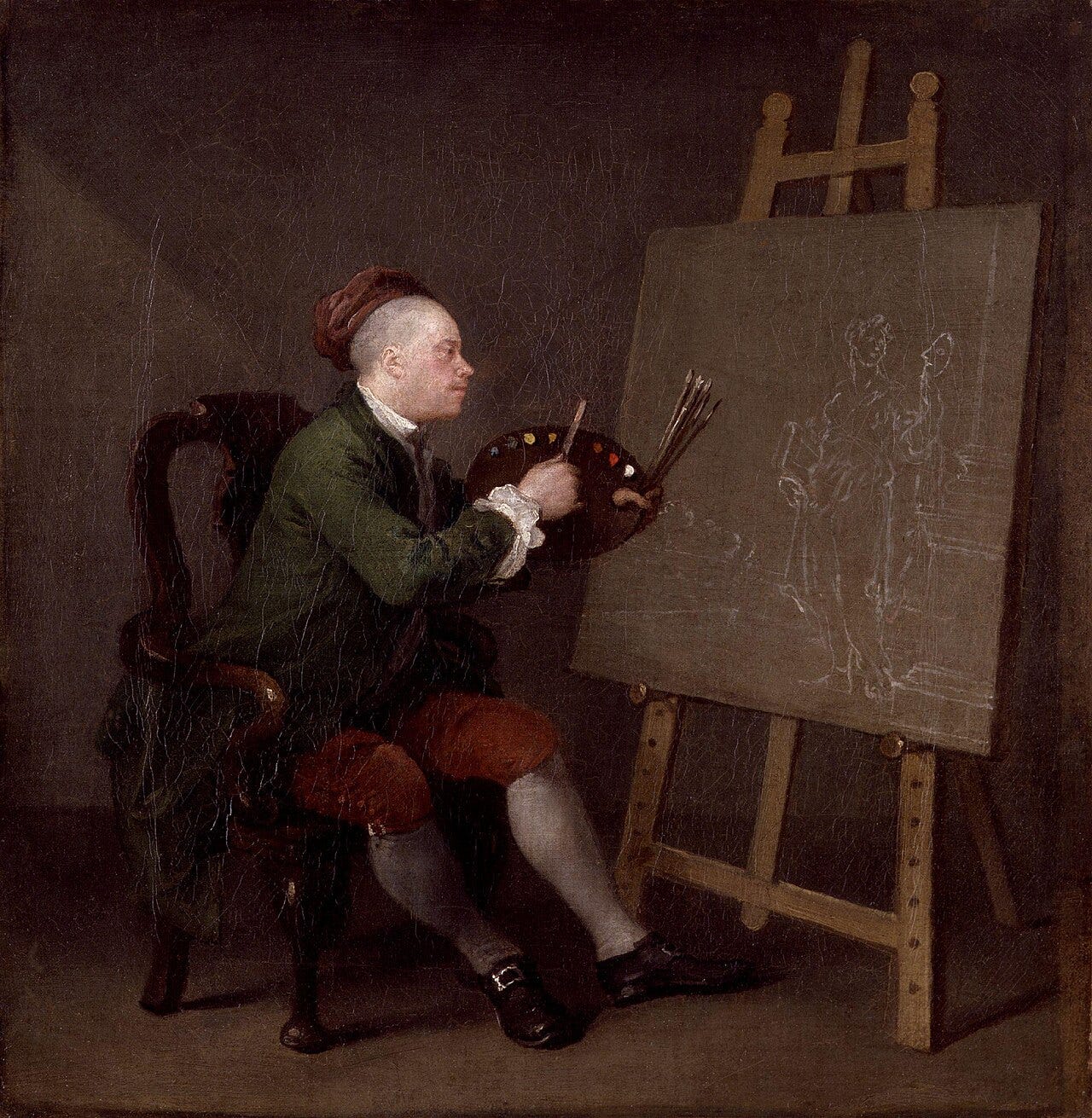
Of the chair in Hogarth’s 1757 self-portrait, Hogarth Painting the Comic Muse, an accompanying label suggested that its (presumably) imported timber might “stand-in for all those unnamed Black and Brown people enabling the society that supports his vigorous creativity.” The aim of these captions was to encourage visitors to think in terms of networks as well as objects, and to be as mindful of what was not on display as they were of what they could see on the wall in front of them. At the same time, however, they excluded the kinds of specific details about the original contexts of these artworks’ creation (and their intended meanings) which might have enabled a viewer to make sense of them as art objects. Potential associations, rather than the art itself, now seem to set the terms for exhibitions and what can (and cannot) be said about the art objects in museum collections. The logic of the feed, metadatafication, and cant trespass on the viewer’s ability to have an un-premeditated aesthetic experience.
As anxious as institutions are to provide them, labels like this can also get between the works and those who simply want to engage with them on their own terms. Years ago, a work colleague described to me some of the frustrations she had felt when she was an English Literature student. Her course readings came to her as a weekly succession of sublime experiences, but in the seminar room she was compelled to discuss them in the much drier terms of applied theory and historical context. There was no opportunity, no space, no language, for talking about the poems in the terms in which she had actually experienced them. Narrowly prescriptive labels risk taking the air out of museum and gallery visitors’ lungs in the same way.
What matters here is not the specific political content of any one label, but the form of explanation that now predominate. In each case, the artwork is treated as a node in a moral network, requiring immediate contextualization. The label becomes a kind of terminal—less an aid to looking than a screen through which contemporary norms are continuously refreshed.
Following its 2022 refurbishment, museum texts at the Burrell Collection in Glasgow now obey similar logic. A sixteenth-century brass dish from Germany depicting the martyrdom of St. Sebastian now has a label noting that, although St. Sebastian was originally a religious figure, he is now “seen as a gay icon” and that “the arrows fired into his body are like the words that can still prick us as LGBTQI+ individuals.” The label reframes the image through contemporary identity categories and invites visitors to locate themselves personally within its meaning, asking, “Who is your icon?”

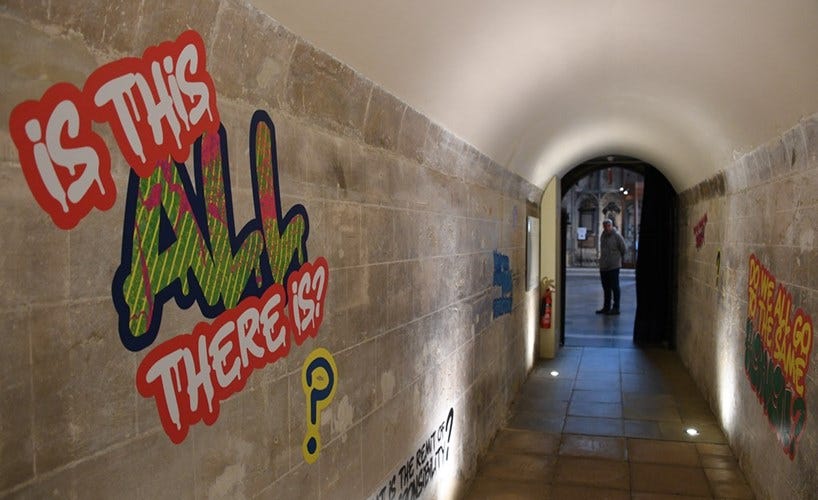
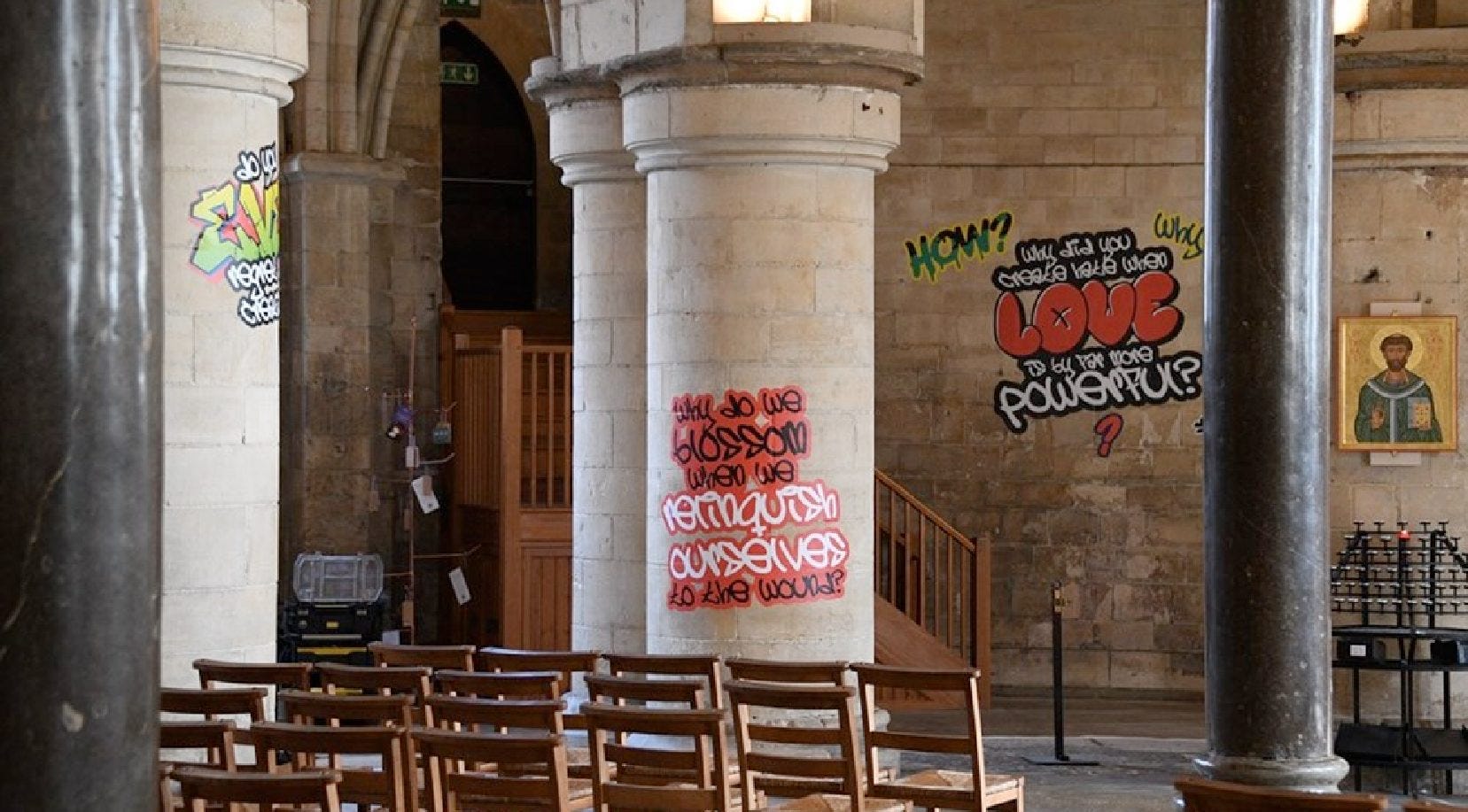
Although the new Burrell Collection texts are printed using the same authority-signaling fonts and visual formats as a conventional museum label, they in practice function more like screens or terminals, receiving and displaying (as though in real time) the most up-to-date signals from “the discourse.” What we might call “activistic ways of knowing” are given formal recognition as a kind of “expert knowledge” through their consecration in the form of gallery text, with its aura of expertise and definitiveness. The new Burrell Collection texts are knowingly provocative. They break the fourth wall of professional convention in order to center (as cant does) the curators’ own emotions and ideological commitments. They make a claim to an unassailable emotional truth through subtly coercive normative frames. The controversial 2025–6 “Hear Us” graffiti exhibition inside Canterbury Cathedral operates according to a similar “terminal-style” logic. Exhibition text posted on the cathedral’s website reported that:
The workshops conducted as part of this project not only ignited inquiries but also stirred up poetic expression, leaving participants feeling affirmed, empathised with, and embraced by their peers. These gatherings offered a platform for individuals to share their perspectives, connect with others who resonated with their questions, and delve into profound discussions about their lives, experiences, and aspirations for change.
Combining public relations and therapeutic language with the style and syntax of a ChatGPT-generated student essay, this text takes one of Gitlin’s definitions of cant (“automated thought”) to its logical conclusion. In the subsequent social media furore, the cathedral walls effectively became a screen for the projection of the contemporary culture war, the (as ever unresolved) clash of polar perspectives offering both sides the illusion of total righteousness.
Liberated from the duty of explaining the past in its own terms, and following the logic of short-form content, cultural history has become increasingly judgmental and present-focused. A compulsion to signal one’s responsiveness to contemporary moral concerns by finding fault with history has become pervasive within the institutions. Even very recent cultural artifacts have come to seem retrospectively “problematic” and in need of mediating commentary and “correction.” Streaming and the culture of the rewatch put older movies and TV shows back into current circulation, inviting new audiences to judge them by contemporary moral norms. As a result, culture is becoming flattened and simplified into a decontextualized mulch, reduced to the lists of rules, shortcomings, and topical talking points that can be applied to it.
The role of rules is to ensure accountability; new categories of retrospective judgment function similarly. The new forms of present-focused cultural criticism enable users to redescribe past works, making them accountable to contemporary moral norms. The result is something like a return to the neoclassical literary criticism of the early eighteenth century, in which the role of the critic lay in separating a past work’s putative “faults” from its “beauties.” The rules of neoclassical criticism included the requirement that virtuous characters be rewarded, while the wicked were made to atone for their actions. Contemporary “culture auditing” performs the same function with new ideals. Now, as then, the moralized idea of the “fault” becomes a way of retrospectively dealing with the problem of historical distance, of squaring past practice with current frameworks. Past “content creators” (working in less “aware” eras) cannot be blamed, it seems, for failing to anticipate current sensibilities. Nevertheless, apparently “outdated” material must be identified (and disavowed) before a work’s “beauties” can be fully endorsed for viewing by contemporary audiences.
The new content warning devised for Mad Men’s season 3 episode “My Old Kentucky Home” (aired originally in August 2009) illustrates the mixture of moralism, auditing, and compliance that typifies the new culture. When the episode was made available for streaming for the first time in July 2020, it was prefaced by a sternly moralistic new title-card, which stated that the episode contained “disturbing images” of “one of the characters … in blackface,” but that “the series producers are committed to exposing the injustices and inequities within our society that continue to this day.”
In this case, it did not matter that the image of Roger Sterling bellowing the episode’s title song in blackface at his country-club Kentucky Derby Day party was clearly intended as both an historical and character critique by the makers of the show. Viewers in 2009 were given strong cues for how to interpret the scene from the visible horror on the faces of in-show moral barometers Pete and Trudy Campbell, as well as by Don Draper’s equally disgusted decision to quit the party at this point and look for the bar. For the episode to be streamed uncut only a decade after its first screening, however, it had to be redescribed (with cantish corporate sincerity) as an “exposure” of “injustice” and “inequity,” as though it were a piece of sociology rather than a self-supporting work of art. As such, it illustrates what the French political scientist Olivier Roy calls the characteristic “explicitness” demanded by the new communication norms associated with digitalization, in which content must be “constantly explicated” to remove ambiguities and “only literal meanings matter.”6 A TV episode that was easily comprehensible in 2009 as (among other things) an implied critique of 1960s upper middle-class American racism becomes “problematic” in 2020 because it trusted its original audience to know what they were seeing.
The contemporary dominance of short-form writing and thinking speaks to our contradictory desire for immediacy—to be “told it like it is”—and our need to feel protected from the potential harms of immediacy’s disclosures. The caption, the content warning, the AI summary, the list of followed accounts—all make versions of the aphorism’s promise (the rapid revelation of an absolute truth). In practice, however, they offer us predigested snippets of information in lieu of the things themselves. What the reduction of reality to tags and topics really enables is ease of consumption. In a world dominated by the logic of flows and timelines, information must be flattened and standardized, its meanings redescribed according to their observable relationship with—their relevance to—other fragments in the feed. When imposed as an explicatory overlay across culture, this logic ultimately negates any sense of ambiguity and strangeness in favour of binary moral certainties.
Cultural explanation is increasingly moving away from describing direct encounters with works or objects in favor of broader commentary with a public relations or stakeholder agenda—how can we make this seem relevant to current issues? To put it in metadata terms, the tag or “topic relationship” must be asserted, no matter how reductive and anachronistic this move may seem according to pre-feed understandings of culture and history.
The consumerist logic of the timeline (with its intrinsic bias towards “new content”) is now being applied to cultural zones that have traditionally been cordoned off from this way of thinking by the concept of historical distance. If it was until recently acknowledged that “the past is a foreign country; they do things differently there,” this exemption no longer seems to hold. The universalizing imperatives of “communicating what is right” must be extended to history’s territories also. In the process, historical explanation has been exchanged for the more immediate pleasures of instantaneous moral judgment. The graph-like certainties of guilt-by-association reasoning are thereby replacing explanation and analysis.
No matter how attractive the “new topicality” may seem to cultural institutions looking to assert their legitimacy and satisfy funders in a rapidly changing environment, it nevertheless imposes significant costs. Once institutions step onto this path, it can become a never-ending treadmill. When cultural value is transferred from the object itself to the object’s capacity for being deemed relevant to “topics of contemporary interest,” the fashion system’s dance with perpetual obsolescence ensues. Topics, jargons, and “critical approaches” move relentlessly onwards. “Badly needed” new contextual labelling needs to be continually updated if it is not to later appear “unresponsive” and cringeworthily behind the times. Nothing ages more rapidly than something specifically engineered to seem fully up to date.
In promising immediacy and easy access to topicality, short-form truths short-circuit our intellectual understanding and aesthetic responses. The crisis of meaning for the arts and culture industries in the 2010s and early 2020s has been the global generalization of these ways of understanding cultural value. Social media has enabled members of the global intelligentsia to become networked and ideologically synchronized with each other, forming an interlinked “global new class” of symbolic workers. The end result of these synchronizations, however, is that everyone has seemingly started speaking and thinking in the same American-derived, quasi-academic jargons, as though standardizing our disciplines in this way was the only path to “contemporary relevance.” In seeking new routes to legitimacy as therapeutic mediators and commentators on the globally agreed Big Topics, we risk cashing in our old institutional legacies for the timeline’s more ephemeral assurances of perpetual relevance and up-to-date-ness, promises that stay good only so long as we remain compliant and connected to the network.
Jean Baudrillard, Fragments: Conversations with François L’Yvonnet, translated by Chris Turner (London: Routledge, 2004), 26.
Rogers Brubaker, Hyperconnectivity and Its Discontents (Cambridge: Polity Press, 2022), 13.
Ben Grant, The Aphorism and Other Short Forms (London: Routledge, 2016), 79.
Susan Sontag, As Consciousness Is Harnessed to Flesh: Diaries 1964–1980, edited by David Rieff (London: Penguin, 2012), 512.
Todd Gitlin, “The Cant of Identity,” in Theory’s Empire: An Anthology of Dissent, edited by Daphne Patai and Will H. Corrall (New York: Columbia University Press, 2005), 400.
Oliver Roy, The Crisis of Culture: Identity Politics and the Empire of Norms, translated by Cynthia Schoch and Trista Selous (London: C. Hurst, 2024), 26.

Thanks for this post. You trace how aphorism differs from feed fragments, and how profiles, metadatafication, and cant shape judgment. The Baudrillard frame carries through museums, timelines, and labels. The Hogarth, Burrell, Mad Men, and Canterbury cases show how explanation yields to signaling, and how immediacy displaces encounter, ambiguity, and history. You pull together a lot that speaks to this moment.
Perhaps the short-form truth is more like a proverb than an aphorism - proverbs often come in matched pairs of opposing judgements. On the other hand, proverb pairs are quite self-sufficient whereas the sorting of opinion into opposing platforms of omnicause tribal affiliation is a powerful process, able to bypass logical filtering (items on the manifesto can be mutually incompatible) and to reconfigure with a holistic speed Quine would have appreciated (Trumpian whims can flip the attitudes of both sides).
P.S. I like the way that 'empathy' is now defined as a self-identified quality expressed by the person empathized with