


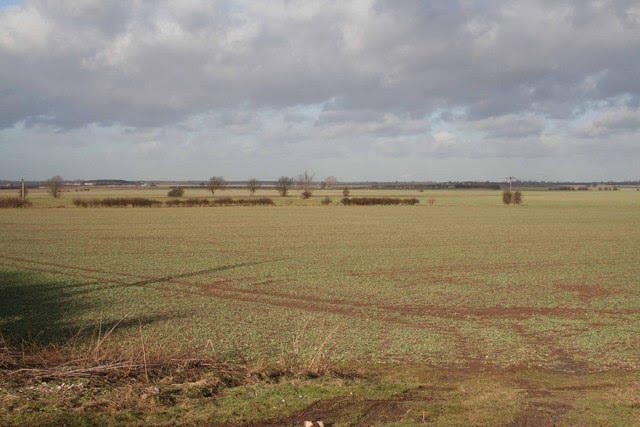
Two summers ago, I bought a condo down the street from an empty lot. It was empty in one sense. There was a chain-link fence around the perimeter, and behind the fence, a pit. I often walked past this minor pit, this rectangular space where, presumably, a building used to be, on my way to the co-op or the library, or on one of my aimless, hourish walks. The pit was attractive—not pretty, of course; it was just a lot of dirt and some litter—but it always drew the eye. It was probably as deep as a backyard pool—just deep enough to be mysterious, and a little bit threatening. You wouldn’t want to fall into the pit; it would be hard to climb back out.
Whenever I walked by this pit, I thought about holes. It put me in mind of John Berger’s “ideal field”: “the field most likely to generate the experience” he’s trying to describe in his short essay, “Field.” The pit, to be clear, was not a field; it was a pit. It was a hole. But was it an ideal hole, the type of hole best suited to my contemplation? An ideal hole has roundness—draw a circle on a piece of paper and it already looks like a hole. My friend Sommer wrote a book, called The Circle Book, in which she drew 99 circles and assigned each circle an interpretation: atom, manhole cover, doorknob. Peep hole. Entrance wound. Abyss. I once read that snails chew perfectly square holes in leaves, but a square hole is not a perfect hole. A hole can make up for what it lacks in roundness or legible shape through grandeur—the wider or deeper or more bottomless the hole, the more sublime it is. The 9/11 memorial holes are square, yet vast, yet so deep you can’t see the bottom of the holes from any angle. The edge of an ideal hole is more vertiginous. I think of the feeling of dropping a ring in the shower. If it lands too close to the drain, the drain becomes a precipice. Edges are where meaning gathers.
John Berger passed his field often, though not every day. “From the city centre there are two ways back to the satellite city in which I live,” he writes:
The main road with a lot of traffic, and a side road which goes over a level crossing. The second is quicker unless you have to wait for a train at the crossing. During the spring and early summer I invariably take the side road, and I find myself hoping that the level crossing will be shut.
This paragraph, the fourth in the essay, is where it becomes clear what Berger is talking about. The first three paragraphs of “Field” are strange, by which I mean, strange for John Berger. His essays usually begin quite directly. “Uses of Photography,” which also appears in his book About Looking, begins with this almost absurdly direct sentence: “I want to write down some of my responses to Susan Sontag’s book On Photography.” The essay “Millet and the Peasant” begins: “Jean-Francois Millet died in 1875.” “La Tour and Humanism” begins: “There is no doubt that Georges de la Tour existed.” “Field” stands out as the only piece in the book to begin with an epigraph, a Russian proverb (“Life is not a walk across an open field”), and the prose of the first page is lyrical, elliptical, almost fictive in its atmospheric approach. The first long meandering sentence is this:
Shelf of a field, green, within easy reach, the grass on it not yet high, papered with blue sky through which yellow has grown to make pure green, the surface colour of what the basin of the world contains, attendant field, shelf between sky and sea, fronted with a curtain of printed trees, friable at its edges, the corners of it rounded, answering the sun with heat, shelf on a wall through which from time to time a cuckoo is audible, shelf on which she keeps the invisible and intangible jars of her pleasure, field that I have always known, I am lying raised up on one elbow wondering whether in any direction I can see beyond where you stop.
Strange—again, for Berger—the way he meanders, and keeps adding clauses, and the way he uses pronouns, calling the cuckoo a she and then referring to the field in the second person (“beyond where you stop”). There are two more paragraphs like this before we get to the point. (If it were me writing this essay, I’d probably start with the fourth paragraph—but I am not John Berger.) That fourth paragraph is where we get the first turn: a shift in style and tone, and a moment of surprise: “I find myself hoping that the level crossing will be shut.” I almost always dislike the construction “I find myself,” or “I found myself”—it’s so often used as a fake transition, a way of pretending your character or persona just popped into existence somewhere, with no agency or memory of a chain of causation. I found myself at the Louvre, people write, as though they were drugged and kidnapped. But Berger’s employment of the phrase feels different. It reminds me of Nietzsche’s idea that a thought comes “when ‘it’ wishes, and not when ‘I’ wish.” In other words, the thought thinks you. Berger here is noticing a counterproductive, contradictory desire: “invariably,” he chooses the route that should be quicker, but then he hopes to be delayed.
This moment of contradiction is where the cycle of the essay’s essential thinking begins: a moment of rupture, between the self’s apparent intention and the self’s underlying desire, which makes itself known through an unexpected hope. The rupture is a feature of the field experience. It’s like flipping a coin to find out which of two equally appealing choices you actually want. You don’t know what you want until you flip the coin; the desire thinks you.
“Field” could be classified as an “I noticed a thing” essay, as my friend Catherine has dubbed it: a meditation on something the writer has noticed. What Berger has noticed is his unexpected wish to be waylaid near the field, and the experience that follows. He knows it’s a recurring experience, familiar and in some way bounded the way that a field is bounded by fence. But the contours of the field experience are elusive. He’s writing in order to define for himself what it means.
The difficulty for him is apparent—it’s why he begins with such uncharacteristic, almost awkwardly lyrical reaching. He knows he is struggling, writing from a place of unsureness: “The experience which I am attempting to describe by one tentative approach after another is very precise and is immediately recognizable. But it exists at a level of perception and feeling which is probably preverbal.” This struggle reminds me of singing a tune that’s a little bit out of your range. The strain to hit the notes increases tension, and strain in a performance is sometimes more moving than mastery.
Berger never ventures to the field on purpose, in much the same way I never went down to the pit near my house just to look at it, to gaze in its abyss; I only looked at it in passing. And this, this accidental-ness, is the first important feature of the field experience: “It is a question of contingencies overlapping,” he writes:
The events which take place in the field … acquire a special significance because they occur during the minute or two during which I am obliged to wait. It is as though these minutes fill a certain area of time which exactly fits the spatial area of the field. Time and space conjoin.
My favorite kind of essay is what you might call a “long-thinking” essay. These are essays about something the author has been thinking about for months, maybe years, and maybe their whole life. “Field” could be classified this way too. One gets the impression that Berger has been having the field experience for a very long time. He’s been through this cycle of thinking repeatedly for years, but hasn’t allowed the thinking to rise to the surface entirely. “Preverbal” thinking, emotion and image, is only semi-conscious. You can’t tell it yet to others, or even, quite, yourself; you might say you literally can’t hear yourself think. In “Field,” Berger is accessing all this long, looping thinking, a messy layering of similar experiences like a Cy Twombly drawing, and trying to put whatever parts of the experience recur and overlap into language. This essay you’re reading, or will be reading, and which I am currently struggling to edit, could be classified this way too.
The long-thinking essay is ritualistic. Whatever experience or material you’re writing about, you’re also writing about the ritual of thinking certain thoughts, a ritual with certain steps or stages. Berger here is writing about the field, but more so, he’s writing about the self and its repetitive encounters with the field. The philosopher Samuel Scheffler has written of tradition as “repository of experience,” and “the kind of wisdom that comes from experience.” This wisdom, in my view, if given a long enough time frame, comes automatically. You may see the moon as an isolated instance for many years, beginning in childhood. Eventually, in your life on Earth, you look at the moon enough times that you start to understand how the moon behaves, day and night, in relation to Earth and the sun. This learning is mostly passive. Repetitive experience is cyclical, it generates automatic meaning, and ritual thinking generates automatic wisdom. This is why essays that come from long thinking are so powerful. Repetitive thinking acquires a tone, a mood, over time—the ritual makes you feel a certain way. And repetitive thinking is structural—it follows a pattern, a pattern that tells you the order of your thoughts.
Structure is a problem that every essay needs to solve. It’s partly one of information management. Consider this simple diagram:
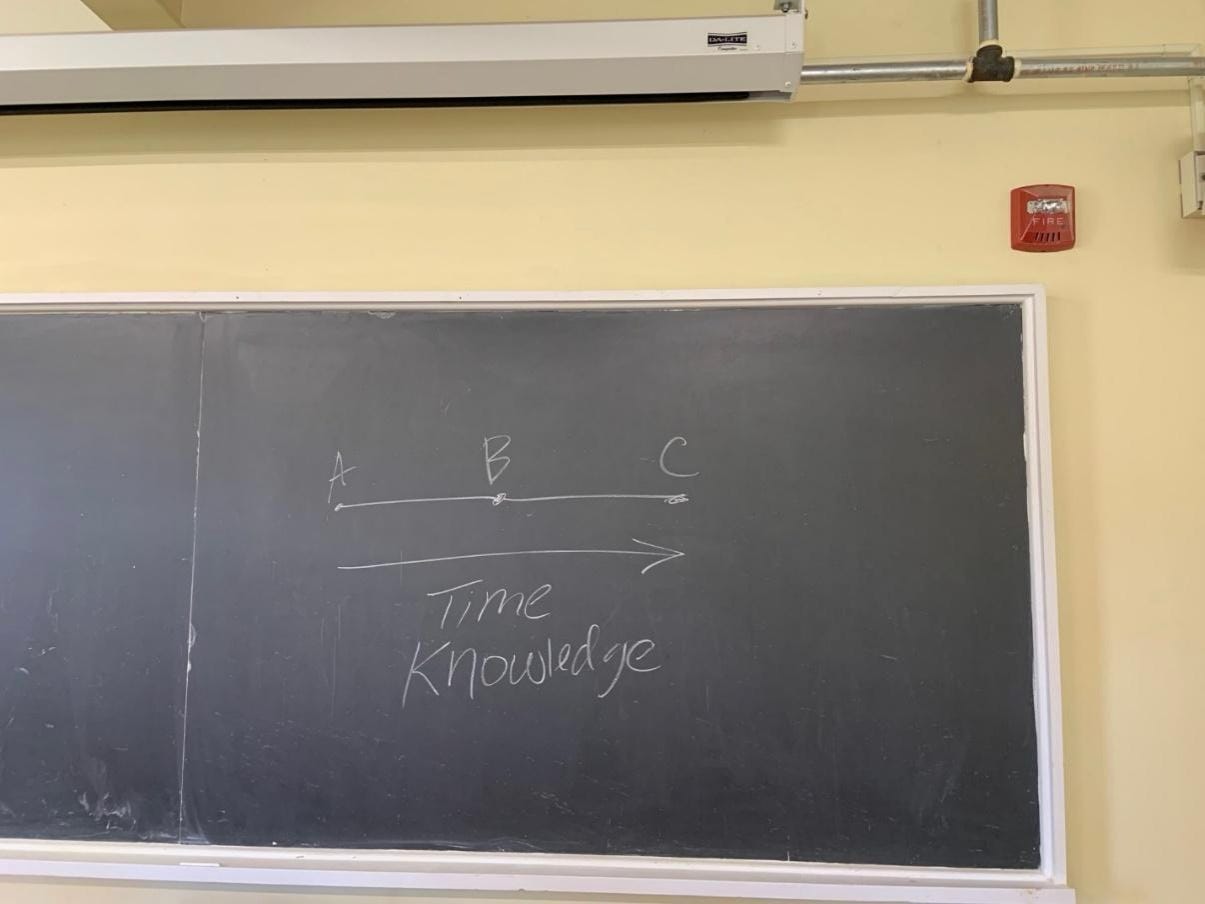
Points A, B, and C are points in time, but also points in knowledge. If you’re writing about events in a linear fashion, you can still only write the events from the knowledge position of point C. The events in themselves have automatic “plot,” automatic suspense. This is because there is deep causation at work in the world, causation going back to the beginning of time in the universe—yet, we don’t know the future. We don’t understand the causation that well. To let this inherent suspense take effect, we can’t reveal everything we know at the beginning. We have to create an authorial persona that remembers what it felt like to be at Point A. (It’s important to note this is already hard. You can doctor the timeline, and structure information in other ways, but telling a story in order is already difficult.) However, the knowledge we bring from Point C, the wisdom of experience, imbues the whole essay, often in subtle, subliminal ways. It’s part of what gives the voice of an essay authority. The task is to bring readers with you on the cycle of thinking, to show the thinking happening, so they can get some inkling of the wisdom you’ve acquired through these years of experience. It’s almost like the essay allows you to cut out all the gaps, the empty time on the tape. You can show the reader a supercut of only the most relevant moments in all this long time. The essay is a way of distilling and concentrating long and slow thinking into something that can be absorbed quickly, in a handful of pages, a thousand or two thousand words, down the hatch, like a magic pill. How do we do that? How do we solve the problem?
Berger has solved the structure of “Field” by beginning the essay in a state of apparently limited knowledge—all evidence suggests that he started on the writing before he’d fully worked out what he wanted to say. When he writes it, in 1971, he may be at Point C, but he’s gone from Point A to Point B to Point C and around again many times, without yet fully understanding the cycle of thinking that accompanies the experience. We could also say he has understood it, but only in that preverbal way which makes it harder to communicate and harder to remember in all its aspects. In the same way that telling a dream to a friend makes it easier to remember, giving a name to a thing helps us know it. We may not have been so lucky as to walk down a country road with Berger, but reading the essay, we feel we’re thinking with and alongside him; we’re given the grace to witness him figuring all this out. And so, when we get to the essay’s last, beautiful sentence (“The field that you are standing before appears to have the same proportions as your own life”) it’s almost as though the idea has occurred to him and to us at the same time.
“It is a striking fact about human life that we have almost no control over our movement through time,” writes Scheffler, in his essay “The Normativity of Tradition.” A personal tradition or ritual, according to Scheffler, is one way we wrest back a little control. These rituals can be very minor and still have significance. The first time I went to a divey karaoke bar in Denver that was called Barricuda (the name was misspelled, with an i), the poet I was with ordered a greyhound. I thought that sounded good, and I ordered the same. Afterward, for years, I ordered that whenever I went there, though I never ordered greyhounds anywhere else. This was a kind of tradition. However small and random in its origins, it lent a certain ceremony to the experience at the dive. The pit, too, became a kind of ritual for me, even though I didn’t really do anything when I passed by the pit, no dance or incantation. Just thinking of the pit as I walked by the pit was its own form of trivial prayer.
For Berger, stopping by the field was more properly holy. The ideal field, in the minute or two of imposed delay, became a kind of canvas, “having certain qualities in common with a painting,” as well as a kind of stage, “a theater-in-the-round.” The field, being framed in this way, in both time and space, allowed him to experience such quiet events as “two horses grazing,” or “an old woman looking for mushrooms,” as though they were art.
The essay becomes a kind of score for the performance, repeatable and enduring. The magical time pill of the essay allows us to enter the same state we enter in ritual, one where time feels layered, present over past, like a ladder we can climb up and down, instead of a relentless moving forward.
This essay is part of Strange Visions, our ongoing series on defamiliarization.

I liked this. It captures how small routines quietly shape the way we think. In my writing, I'm trying to describe why. “From this open–close rhythm, the universe drafts a rule set that governs cause–effect behavior. When pressure decreases, the molecular boundary opens to seek connection, allowing contact, exchange, and shared load. When pressure increases, the boundary closes to preserve its integrity. And when conditions settle into the narrow viable band between those extremes, the system holds a steady oscillation — the stable expression of the pressure‑conditioned choreography that governs boundary behavior” (From my Genesis Inevitable).
Love the term "long-thinking essay!"